Showing posts with label stock. Show all posts

Tuesday, December 27, 2011

Braised Pork Belly (Fresh Bacon)

Anyone who knows me, knows that I love bacon. Pork belly, also known as "fresh bacon," is simply uncured slab bacon. It's where bacon comes from, so it follows that I would love it just as much as I love its smokey, crispy, mouth-watering relative. To no one's surprise, it turns out that I do.

Braised for hours in stock and aromatics, pork belly can be as tender as fillet of beef, but with so much more flavor. Just like a strip of bacon, the belly is composed of layers of fat and meat. Slow cooking helps to soften the tough layers of meat, while also infusing the tender layers of fat with the flavors of the braising liquid. When I buy belly, I try to look for pieces that have a good balance of fat and meat. Too much fat can be overwhelming in the mouth, and too much meat can result in a dry final product.
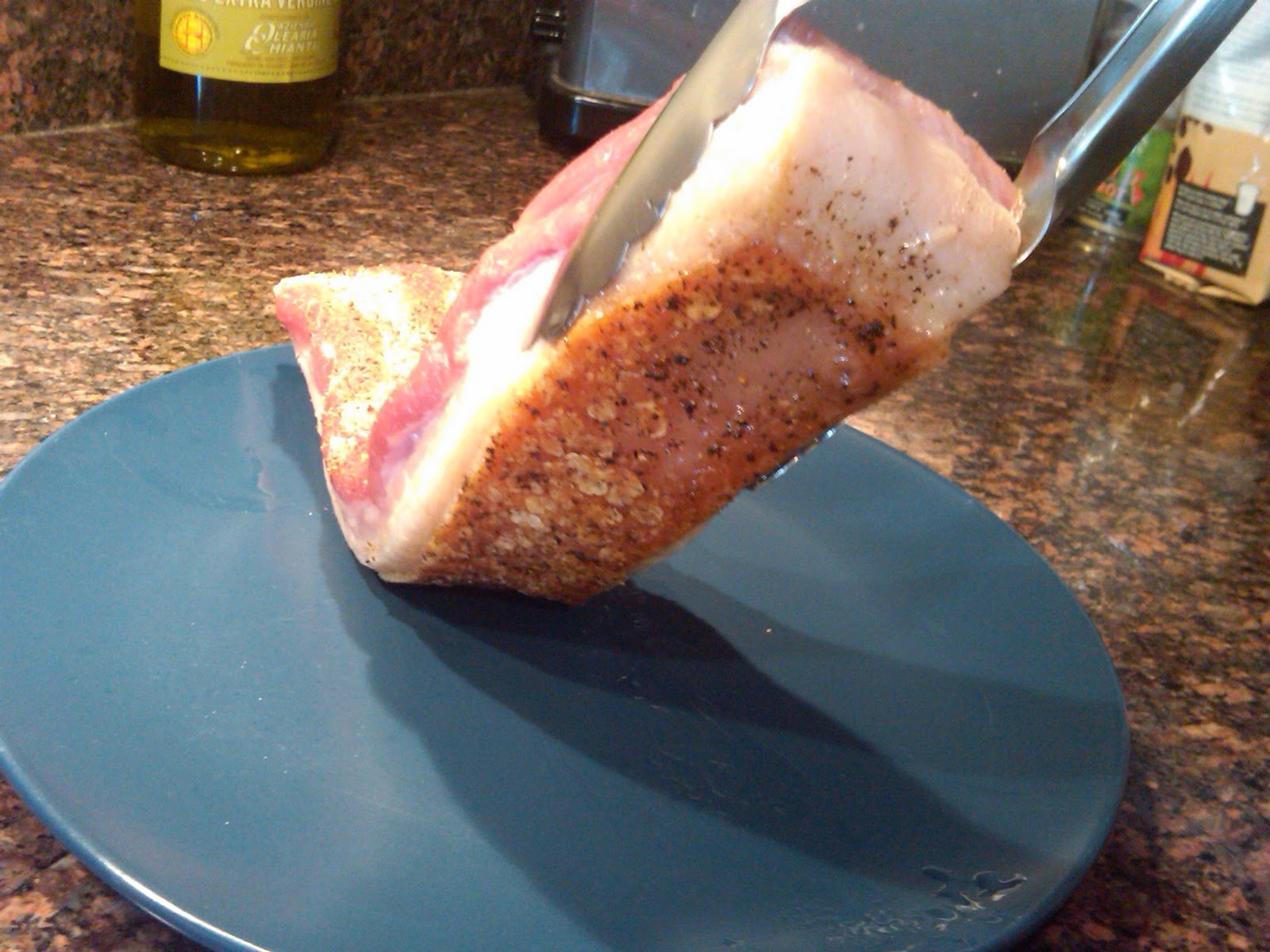
This recipe is based on Tom Colicchio's recipe for fresh bacon in "Think Like A Chef." The first few times I attempted Colicchio's recipe, I was always happy with the belly itself but couldn't quite nail the sauce. The original recipe finished the belly by browning it in a hot oven with the braising liquid still in the skillet. Something about putting that beautiful sauce in a hot oven ruined it every time. As a solution, I strain my braising liquid into a small sauce pan and gently reduce on the stove top until I get it just right. Meanwhile, I brown the belly with a little bit of extra stock, instead of my precious sauce.

The belly can be prepared through step 3 and held for several hours before completing. When buying pork belly, be sure to ask your butcher to leave the skin on. Also, try to pick a piece of belly that is relatively uniform in thickness. Pork belly is so cheap, don't be afraid to buy more than you need and trim it down to the choicest pieces at home. Serve with mashed potatoes, soft polenta, or our polenta cakes.
 

Ingredients

1 tablespoon canola oil
Kosher salt
Freshly ground black pepper
2 pounds pork belly, skin on
1 onion, roughly chopped
2 carrots, roughly chopped
2 celery stalks, roughly chopped
1 leek, white and light green part only, roughly chopped
6 garlic cloves, peeled
 
4 cups chicken stock


Instructions
  1. Heat oven to 350°F. Heat the oil in a large ovenproof skillet over medium heat until shimmering. Generously season the pork with salt and pepper. Add it to the pan, skin side down, and cook until the skin is well browned, about 15 minutes. Transfer the pork to a plate.
  2. Pour off all but about 2 tablespoons of the fat and add the onion, carrots, celery, leek, and garlic to the skillet. Cook the vegetables, stirring occasionally, until they are tender and beginning to brown, about 20 minutes. 
  3. Return the pork belly to the skillet, skin side down and fat side up, and add about 2 cups of stock (it should surround but not cover the meat). Bring the stock to a simmer, then transfer the skillet to the oven. 
  4. Gently simmer the pork, uncovered, for 1 hour, then add another cup of stock. Continue cooking until the pork is tender enough to cut with a fork, about 1 hour longer.
  5. Remove the skillet from the oven and allow the pork to cool in the braising liquid. This will take at least one hour.
  6. When ready to complete, increase the oven temperature to 400°F. 
  7. Remove the pork from the liquid, then gently lift off and discard the skin (use a small knife to separate any pieces that don’t come away from the fat easily). Score the fat, making crosshatch incisions, then cut the pork into 4 portions. This is rich stuff, so I recommend serving no more than one, 2-inch square piece to each guest.
  8. Strain the braising liquid through a fine mesh strainer into a small saucepan and discard the solids. Bring to a simmer over medium-low heat and reduce to a sauce-like consistency, skimming off any fat that rises to the surface. 
  9. Meanwhile, return pork, scored side up, to the skillet. Pour the remaining 1 cup of stock around the pork and transfer to the oven. Allow to cook, without basting, until the pork is heated through and the fat nicely browned, about 20 minutes.
  10. Serve the pork in shallow bowls with some of the sauce ladled over the top and around the meat.

Sunday, July 31, 2011

Polenta Cakes

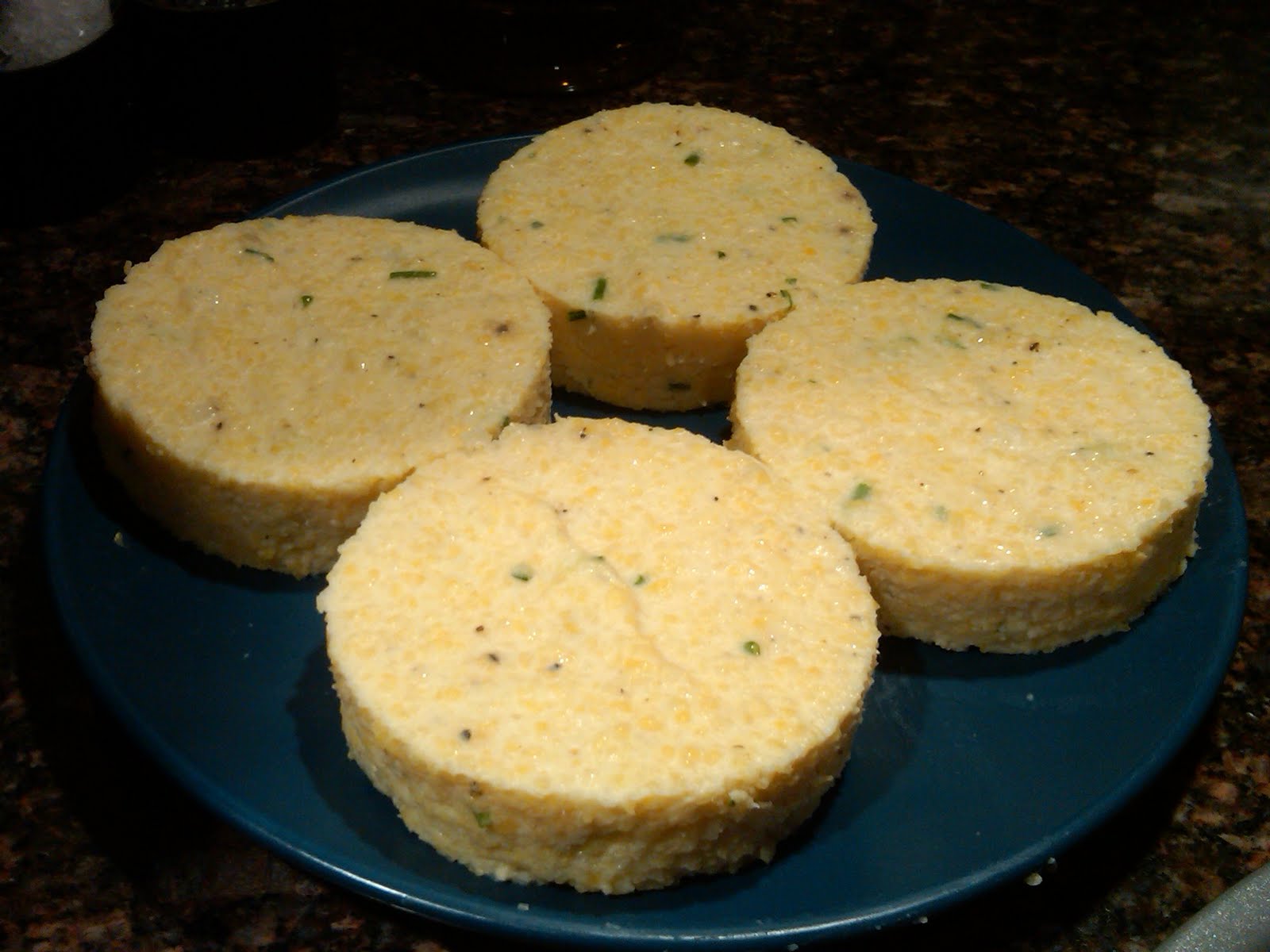
There are two kinds of polenta in life. Creamy polenta, like grits, should collapse when ladled directly on a plate. Firm polenta is usually served shaped and is often fried to crisp the top and bottom. These would be the latter kind. From Thomas Keller's French Laundry cookbook, these polenta cakes are the kind of thing I usually think of as a restaurant dish, but it turns out are perfectly accessible and manageable to make in the home, especially for company.

This polenta cake recipe we paired with TK's fantastic short ribs, and the very rich sauce and very rich polenta really gave a wonderful restaurant quality feel. Although not a weekday item, they make a decent company side, because you have to chill them down and wait, and preparing things ahead is the key to successful dinner parties. You can even pre-cut the circles using a biscuit cutter, cookie cutter, or baking round, put them on a plate, and then just fire them up on the stove a few minutes before serving. And since the nature of the recipe kinda forces you to make a lot (you have to harden the polenta in a baking dish prior to cutting the cakes, and baking dishes can only be so small), it makes sense for guests, or to make some for now, and save the rest for a second meal later.

If you're not like me and don't have things like mascarpone cheese on hand (shocking, I know), you can try substituting equal parts cream cheese and sour cream. All this being said, just like sour cream is just not the same as creme fraiche (though easily substitutable for), nothing is truly like mascarpone. Just make sure to adjust any necessary firming times. Make sure to use regular polenta, not instant polenta. Extra fine polenta that is low in starch and has not been processed is also useable and will speed up your cooking time.

Polenta Cakes

Ingredients

2 1/2 cups chicken stock
3 cups water
1/2 teaspoon minced garlic
1 1/2 cups polenta
8 tablespoons unsalted butter, at room temperature
2 tablespoons marscapone
2 tablespoons minced chives
Kosher salt and freshly ground pepper
Flour


Instructions
  1. Bring the chicken stock, water, and garlic to a boil in a saucepan.
  2. Whisking constantly, pour in the polenta.
  3. Return the liquid to a simmer and cook the polenta over very low heat, stirring occasionally, for 25 to 35 minutes, or until the polenta is thick and smooth.
  4. When the polenta is cooked, stir in the marscapone, butter, chives, and salt and pepper to taste.
  5. Spread the polenta in a 9 x 13 inch baking pan. Let it cool to room temperature.
  6. Once cooled, cover the surface of the polenta directly with plastic wrap to seal off air and refrigerate. Allow plenty of time for the polenta to fully firm up (at least three hours).
  7. With a 2-inch round cutter or biscuit cutter (or similar size), cut 8 rounds into the firm polenta.
  8. Heat about 1/8" of canola or vegetable oil in any ovenproof skillet to medium heat.
  9. Add some flour to a round cake pan and gently coat the pieces of polenta with flour. Shake off any excess.
  10. Add floured polenta round to the skillet and cook for 2-3 minutes on each side (until evenly browned on both sides and hot. If they brown too quickly (before the center is hot), the pan can be placed in a 350 degree oven to finish cooking.
  11. Serve warm. Any leftover polenta can be saved for three days.

    Saturday, July 30, 2011

    Frogmore Stew


    Not really a stew at all, but rather a boil of potatoes, corn, shrimp and spicy-smoked sausage, frogmore stew is a very traditional Southern dish, indigenous to the Carolinas but common along the Gulf coast as well. Traditionally, all of the ingredients are boiled in heavily-seasoned water, strained and eaten family-style. My mom likes to make frogmore stew for dinner at the height of summer. It’s a great way to highlight the amazing corn available in July and August, and the heat in the dish can make even the hottest summer night seem cool by comparison.

    My version of frogmore stew is a bit more refined than the original. To build my boiling liquid, I start with a base of chicken stock and water, which I slowly simmer with onions, tomatoes, roasted red peppers, herbs and spices until dark and heavily flavored. Because I put so much work into my boiling liquid, I figure it would be a shame not to serve it. So I serve individual portions of the corn, potatoes, shrimp and sausage in wide bowls with some of the boiling liquid ladled over.

    I recommend Andouille sausage for this recipe. You can substitute another spicy sausage for the Andouille, but make sure whatever sausage you use is spicy enough to sufficiently flavor the boiling liquid. If using a milder sausage, add additional red pepper flakes to the broth in step 3. Similarly, I recommend using head-on shrimp for this recipe. The heads add great flavor and brine to the boiling liquid. If you’re not using head-on shrimp, consider adding some additional salt to the boiling liquid in step 4.

    Serve with crusty bread and remember to put out an extra bowl for shells and corn cobs.

    Frogmore Stew

    Ingredients

    2 pounds Andouille sausage, or other spicy sausage
    2 large red bell peppers
    olive oil
    8 cups chicken stock
    8 cups water
    2 medium onions, peeled and halved end-to-end
    1 large tomato, cored and cut into 1-inch chunks, or 1 16 ounce canned-diced tomatoes, drained
    6 garlic cloves, smashed
    10 sprigs fresh thyme
    6 bay leaves
    1 tablespoon whole black pepper corns
    ¼ teaspoon crushed red pepper flakes
    Kosher salt
    10-12 small new red potatoes, halved
    4 ears corn, husks and silver threads removed and broken into 2-3 pieces each
    2 pounds shrimp, shells and heads on

    Instructions

    1. Adjust oven rack to upper-middle position and pre-heat oven to 425F. Poke each link of sausage several times with the twines of a fork, and place on a non-stick baking sheet. Lightly oil the peppers with the olive oil, and place on the baking sheet with the sausages. Place the baking sheet in the oven and roast for 20 minutes, or until the peppers are beginning to blister and the sausages are deeply browned.
    2. Remove the baking sheet from the oven and allow the peppers and sausages to cool. When cool enough to handle, cut the sausages on the bias into 2-inch pieces and set aside. Cut each pepper into 6 or 8 pieces, making sure to remove any seeds, and set aside.
    3. Put the chicken stock and water in a large stock pot, along with the onions, tomato, roasted peppers, garlic, thyme, bay, black pepper corns, red pepper flakes and salt to taste. Place over medium high and bring to a simmer. Reduce heat and simmer for one hour, skimming off any foam that rises to the surface.
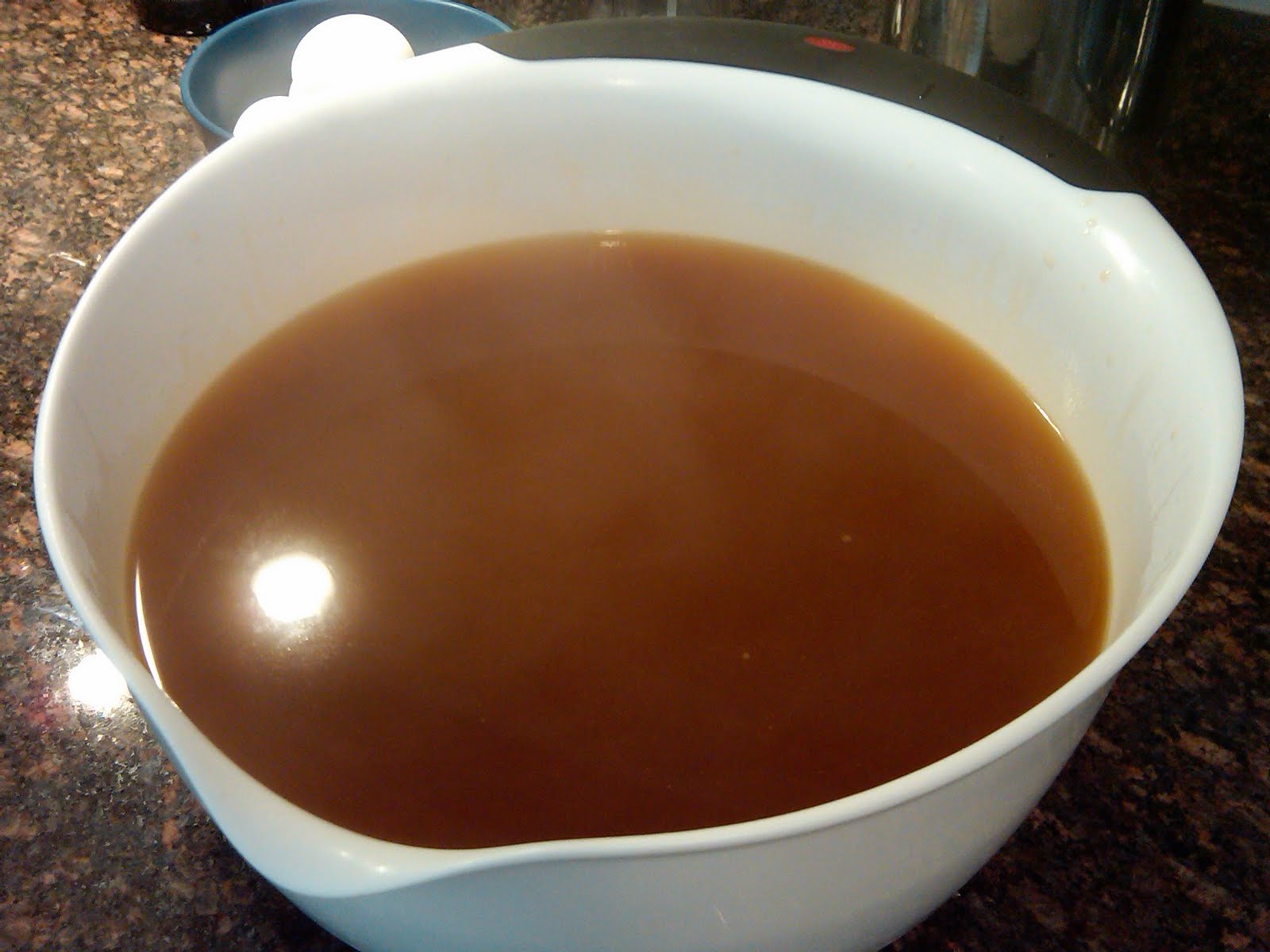
    4. Strain the boiling liquid through a fine mesh strainer into a large bowl. Discard the solids. Taste the boiling liquid to make sure that it is heavily seasoned. Add additional salt as necessary.
    5. Wipe out the stock pot and then strain the boiling liquid through a fine mesh strainer back into the stock pot. Straining twice will result in a cleaner liquid. The boiling liquid can be set aside at this point for several hours until you’re ready to prepare the stew.
    6. Bring the liquid to a gentle boil over medium to medium-high heat. Taste the liquid again. If it seems over-reduced, thin it out with a little water. Add the potatoes to the liquid, partially cover the pot and boil for 15 minutes, adjusting heat as necessary to maintain a gentle boil.
    7. Add the corn and sausage to the liquid, partially cover the pot and boil for 10 more minutes, or until the potatoes are fully cooked.
    8. Add the shrimp to the pot and cook, covered, for another 3 to 5 minutes, or until the shrimp are just cooked.
    9. Place one piece of corn in each of four wide bowls, along with a few pieces of potato, a few pieces of sausage, and several shrimp. Ladle a little of the boiling liquid over each bowl, and serve immediately.

    Monday, March 21, 2011

    Spring Vegetable Risotto

    This risotto is a giant bowl of Spring and freshness. It's beautiful to serve and to look at, with the bright green asparagus and green peas poking out of the cheesy, smooth risotto. And the done-up broth and lemon add a level of freshness that just really brings the whole dish together. It's also a recipe of not-wasting, as you use the leftover stems, rough leek greens, asparagus ends, and other leftover bits from prep to infuse the broth with even more freshness. It's not in the recipe because its not a mushroom risotto, but if you have any mushrooms stems to add from another project, you should do so, as it adds a nice umami flavor to the veggie broth (if you are doing this vegetarian). This recipe is pretty much a testament to the wonders of making your own broth, so be sure not to skip this step!

    I tend to not put as much mint as the original Cooks Illustrated recipe calls for. I like the stems in the broth, but I'm just not a fan of the raw texture of mint in much anything. I am however, a fan of garlic in EVERYTHING, so I've upped the amount of garlic in the recipe. (So if you are like me and add two extra cloves of garlic to most recipes, fear not, I have added them already!) It can be a little difficult to judge when the rice has become "transparent on the sides" so I try to stick to the time estimate there. As far as when the liquid is gone, I judge that by if you drag a rubber spatula across the bottom of the dutch oven, does the cleared line remain clear or does the risotto fall back and cover it with liquid immediately? When it stays dry, it's time to add more liquid or move on in the recipe. The exception is this is the last time, where you want to keep it a LITTLE wetter than you have prior just to ensure that once its off-heat and butter, lemon juice, and cheese have been added, it does not get too stiff. If it does, you can loosen it with a little more stock at the end, but be careful not to overdo it. You don't want the initial taste of the dish to be stock rather than lemon.

    Cooks Illustrated includes a note on substituting onion for leek (1 for the broth, 2 for the risotto). I've never tried it, and think it would be a shame not to include the leeks because leeks marry so well and add even more green to the recipe. On the other hand, if you have no leeks, this could be an option. Be sure to remember the lemon at the end. The citrus really brings out the freshness of the veggies.

    Spring Vegetable Risotto

    Ingredients

    2 tablespoons minced fresh parsley leaves, stems reserved
    1-2 tablespoons minced fresh mint leaves, stems reserved
    1/2 teaspoon finely grated zest from 1 lemon
    1 pound asparagus , tough ends snapped off and reserved, spears cut diagonally into 1/2-inch thick pieces
    3 medium leeks , white and light green parts halved lengthwise, washed, and sliced thin (about 4 cups), roughly chopped tough greens reserved
    4 cups low-sodium chicken broth or vegetable broth
    3 cups water
    5 tablespoons unsalted butter
    1/2 cup frozen peas
    4 medium garlic cloves, pressed through garlic press
    11/2 cups Arborio rice
    1 cup dry white wine
    1 cup grated Parmesan cheese (3/4 cup for recipe, 1/4 cup for serving)
    1-2 tablespoons juice from 1 lemon

    Instructions

    1. For the Gremolata: Combine minced parsley, mint, and lemon zest in small bowl, reserving the rest of the lemon for juice and the parsley and mint stems for broth. Set aside.
    2. For the Broth: Chop tough asparagus ends and leek greens into rough 1/2-inch pieces. Bring chopped vegetables, reserved parsley and mint stems, broth, and water to boil in large pot over high heat. 
    3. Reduce heat to medium-low, partially cover, and simmer 20 minutes. 
    4. Strain broth through fine-mesh strainer into medium saucepan, pressing and squishing the solids against the strainer to extract as much liquid as possible. Trash the solids. 
    5. Cover and set over low heat to keep broth warm. This can be done in advance and brought back to low heat prior to starting the risotto.
    6. For the Risotto: Heat 1 tablespoon butter in large Dutch oven over medium heat. When foaming subsides, add asparagus spears, pinch of salt, and pepper to taste. Cook, stirring occasionally, until asparagus is crisp-tender, 4 to 6 minutes. 
    7. Add peas and continue to cook 1 minute. Transfer vegetables to plate and set aside.
    8. Melt 3 tablespoons butter in now-empty Dutch oven over medium heat. When foaming subsides, add leeks, garlic, 1/2 teaspoon salt, and 1/2 teaspoon pepper. 
    9. Cook, stirring occasionally, until leeks are softened, 4 to 5 minutes. 
    10. Add rice and cook, stirring frequently, until grains are translucent around edges, about 3 to 4 minutes. 
    11. Add wine and cook, stirring frequently, until fully absorbed, 2 to 3 minutes.
    12. When wine is fully absorbed, add 3 cups hot broth to rice. Simmer, stirring every 3 to 4 minutes, until liquid is absorbed and bottom of pan is almost dry, about 12 minutes.
    13. Stir in about 1/2 cup hot broth and cook, stirring constantly, until absorbed, about 3 minutes; repeat with additional broth 3 or 4 times until rice is al dente. 
    14. Off heat, stir in remaining tablespoon butter, Parmesan, and lemon juice. 
    15. Fold in asparagus and peas. If necessary, add up to 1/4 cup additional hot broth to loosen texture of risotto. 
    16. Sprinkle each serving with gremolata and Parmesan and serve immediately

    Thursday, March 17, 2011

    Braised Lamb Shanks

    The shin portion of the leg, lamb shanks are best when braised until tender and falling off the bone. As a kid, braised lamb shanks were one of my favorite things to order when my family would go out for nice dinners. I loved how the meat would melt in my mouth, and I found there to be something particularly satisfying about leaving only the giant bone on my plate. Today, when I serve this dish to guests, I like seeing them get as excited about eating it as I did when I was a kid.

    Over the years I’ve made several versions of this dish, but this is my favorite. The spice mixture is based on the lamb shank recipe in Joy of Cooking, and includes coriander, cumin, cinnamon and allspice, all of which pairs beautifully with the lamb and will make your apartment smell amazing. I re-brown the shanks in the oven after braising, and then perch them on top of small-cut carrots and potatoes that cooked with the lamb. It makes for a particularly classy presentation, but you could just as easily serve the shanks over buttered egg noodles and save yourself some work.

    Be patient when trimming the shanks; the more fat and silver skin you trim away, the more tender your shanks will be after cooking. You can substitute essentially any root vegetables for the carrots and potatoes used here, just make sure to cut them into equal sized pieces to ensure even cooking. If your Dutch oven isn’t large enough to hold the shanks in one layer, prepare the shanks though step 3, and then transfer the shanks and prepared braising liquid to a roasting pan and cover tightly with aluminum foil to braise.

    Braised Lamb Shanks with Carrots and Potatoes

     
    Ingredients
    2 lamb shanks
    Kosher salt
    freshly ground black pepper
    4 tablespoons olive oil
    2 medium onions, halved pole-to-pole, and cut into ¼ inch slices
    4 large garlic cloves, chopped
    1 teaspoon ground coriander
    1 teaspoon ground cumin 
    ground cinnamon
    ground allspice
    2 cups chicken stock or lamb stock 
    1 cup dry white wine, such as sauvignon blanc 
    1/3 cup tomato puree 
    2 cups carrots, cut into ½ inch pieces
    2 cups small yellow potatoes, cut into ½ inch pieces
    1 tablespoon finely grated lemon zest
    2 tablespoons parsley, chopped

    Instructions


    1. Adjust oven rack to middle position, and preheat oven to 300°F. Using a long, thin knife with a semi-flexible blade, trim as much external fat and silver skin from the lamb shanks as possible. Generously season the trimmed shanks with Kosher salt and freshly ground black pepper.
    2. Heat 2 tablespoons of the olive oil in a Dutch oven large enough to hold the shanks in a single layer over medium-high heat until shimmering but not smoking. Add the shanks to the pot and brown well on all sides, 6 to 10 minutes. Remove the shanks to a plate, and pour off the fat from the pot.
    3. Reduce heat to medium, and add remaining 2 tablespoons olive oil to pot, along with the onions and garlic. Cover and cook, stirring occasionally, until the onions are quite soft, about 10 minutes. If onions begin to brown, lower the heat a bit. Add coriander, cumin, ½ teaspoon black pepper, a pinch of ground cinnamon and a pinch of ground allspice to pot. Stir well to coat the onions. Add stock, wine and tomato puree to pot. Using a wooden spoon, scrape up any brown bits from the bottom of the pot. Increase heat to high and bring to a boil.
    4. Return lamb shanks to pot, cover, place in pre-heated oven and bake for one hour. After one hour, add potatoes and carrots to pot, and continue to bake for another hour, or until the meat is falling off the bone.
    5. Remove pot from oven and place on stovetop. Increase oven temperature to 400°F. Remove shanks from pot and place on baking sheet. Once the oven has come up to temperature, place shanks in oven and allow to re-brown. Meanwhile, finish the sauce.
    6. Strain the braising liquid into a medium saucepan and bring to a simmer over medium heat. Simmer the sauce until thick and velvety, about 10 minutes, skimming off any fat that rises to the surface. Once thickened, season to taste with Kosher salt and freshly ground black pepper. Meanwhile, separate the potatoes and carrots from the onions, and discard the onions (they will have given all their flavor to the sauce at this point). Combine the chopped parsley and lemon zest in small bowl.
    7. To serve, divide the potatoes and carrots between two shallow serving bowls. Top each pile of vegetables with a lamb shank, and then ladle enough of the sauce over each shank to almost submerge the vegetables. Finish each plate with a sprinkling of the parley and lemon zest mixture, and serve.